


.jpg)
.jpg)

How and why to remove an interior door handle?
This guide describes the steps to diagnose and remove the old door handle without difficulty
This guide describes the steps to diagnose and remove the old door handle without difficulty
We rely on door handles every day and generally do not think much about them until they cause problems. In this article, we will cover certain scenarios in which you might need to replace a door handle and how to do so. Door handles may seem complicated, but the good news is that you do not need to be an expert or have experience to correctly replace a door handle. Simply follow this guide and you will be well on your way to a job well done.
Diagnosing what is wrong with your door handle

Start by determining the reasons why you wish to replace an interior door handle. In some cases, it is possible to resolve the problem without replacing the handle, but replacing the handle is generally a simple and effective way to remedy the issue. Moreover, it allows you to choose a handle that matches your precise preferences if you are not satisfied with the latch you currently have on your door. Perhaps now is the right moment to add a new colour to the handle and change the look? Here are five problems that may justify replacing your interior door handle.
1. The handle is loose
One of the reasons you might want to replace your current door handle is that it feels loose. Loose handles move or pull away from the door when you pull on them. This can be a nuisance and means that your door handle is not doing its job properly. Door handles can become loose over time due to normal wear and tear. In some cases, the door handle may have a loose or missing screw — check the fixings! In this case, replacing the missing screw or tightening the loose screw may be enough to resolve the problem. However, other issues may be causing a loose door handle, such as a faulty locking mechanism. Our advice: whatever the cause of the loose door handle, installing a new handle should resolve the problem.

2. The components are misaligned
Another reason you may want to install a newer door handle is that your door does not open and close properly due to misaligned components. The person who installed the current door handle may not have aligned the parts of the locking mechanism correctly. The components can also become misaligned over time if the door or door frame warps slightly. You may be able to remedy this problem by removing the old strike plate, which is fixed to the door jamb, and repositioning it so that it is better aligned with the bolt. First make sure that your door is hung straight and at the correct level. If the door is not hung as it should be, this could be the true source of the misalignment problem. You can also resolve this problem by starting with a brand-new door handle. When you install it, you can take care to ensure that everything is correctly aligned.


3. The lock is stiff
Another problem you may encounter with door handles, especially when they are old, is a stiff or seized locking mechanism. As dust and dirt build up in the internal components of the handle, the locking mechanism can become stiff or seize up completely. If you feel you have to exert too much effort to turn your door handle, this is a sign that it is time to replace it. The advice of Millapoignees — why not take the opportunity to install magnetic locks? You can also try cleaning the door handle, but you may find it easier to replace it with a new handle that turns and works without any problem. If you want to try cleaning it, there are several methods you can try. The first involves working graphite into the internal mechanism by passing it through the keyhole and turning the lock several times. The other involves using a lock de-icer, a formula that dissolves the dirt that may be preventing the locking mechanism from working correctly.


4. The handle has no lock
Even if a door handle works correctly, in accordance with its design, you may need to replace it. For example, some interior door handles do not lock. While this makes sense for a cupboard door, for bedroom and bathroom doors, most people prefer a handle that allows them to lock the door. If the handle on a bedroom door or another interior room in your home is not fitted with a lock, the only way to resolve this issue is to replace the handle. If you want to keep the old knob, you will need to add a latch lock that will hold the door in place. If you decide to install a new door handle with a lock, make sure to position it correctly so that someone can lock the door from the inside.
5. The door handle is unsightly
Finally, you may wish to replace a door handle because you do not like its appearance. You are not obliged to put up with a door handle you dislike simply because it works. Although door handles may seem like a small detail, they can have a significant impact on the style of your home. Door handles should complement the style of your home, rather than detract from it. For example, if your home has a modern and elegant style, an old tarnished or paint-covered long door handle will probably look out of place. By replacing your old door handle with a beautiful modern handle, you will enhance the style of your home. If you want your door handles to harmonise with the rest of your home, pay attention to the type of finish on various fixtures, such as taps and light fittings, throughout your home and match that finish to achieve a cohesive feel throughout the house (you can read more on the subject here).

How to remove the old door handle
Once you have decided to replace an interior door handle, you can get to work removing the old handle, choose a new one you like, and then install it. This process should not intimidate you. Although not all door handles have an identical design, the same fundamental steps apply to the majority of door handles. Let us take the time to go through these steps so that you are ready to replace that faulty or outdated handle with a new one that works correctly and has the look you want. All you need to replace an interior door handle is a screwdriver and the new replacement door handle. A drill and a 3 mm Allen key may also be useful.
Remove and replace the door handle
Let's start with the steps to follow to remove the old door handle. It is preferable to remove the old handle before buying a new one to make sure you choose a door handle that fits correctly in the space left by the old latch.
1. Remove the handle
1.1 Removing a Long-Handle with Screws
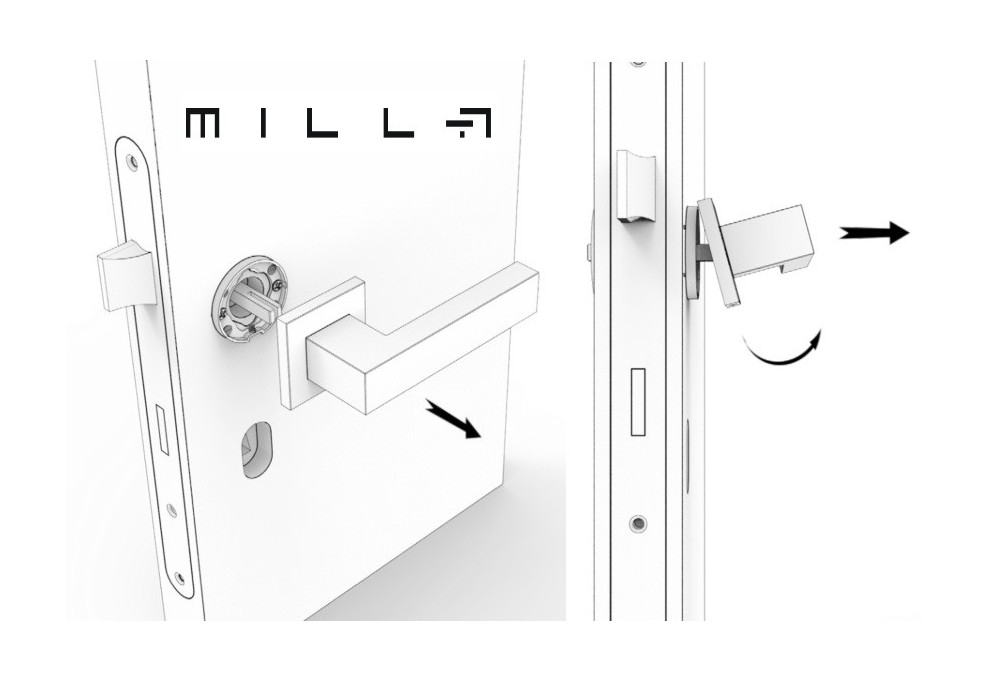
How do you remove a long handle? Start by placing an object, such as a towel, between the door and the door frame to keep it open. Using your cross-head screwdriver, remove the screws that hold the door handle firmly to the door. In most cases, you will only find these screws on one side of the door, but check whether you have screws on both sides to remove. Alternate between the two screws, loosening them a little at a time, so that the handle comes off evenly. After removing the screws, the handle should come out, along with the square steel spindle that holds the two handles together. If you cannot see any screws, there should be a small tab that you can press in with your screwdriver to release the handle.
1.2 Removing a Handle on a Backplate (square or round)
Wondering how to remove a handle on a backplate? A clarification is needed regarding handles on a square, round, or concealed backplate. These handles are generally "clipped" onto the adaptor, so to remove the escutcheon (the backplate), you need to gently lever it off with a thin flat-head screwdriver. Be careful not to damage the door! Sometimes the escutcheon (the handle backplate) is simply screwed onto the thread, so you need to unscrew it by hand without using any tools. Once this is done, you will have access to the screws holding the handle adaptor to the door. Simply unscrew the screws and carefully remove the adaptor. The wood may be in poor condition or have many holes. No problem, as a rose from a new handle will cover everything. Then remove the roses located beneath the handle. This small plate serves to cover the lock entry and surrounds the piece that protrudes to keep the door in place when you close it. Using a flat tool, remove the screws to take off the locking plate.

2. REMOVE THE LOCK
Once you have removed the door components, turn your attention to the door jamb. This is where you will find the strike plate (the lock) with its faceplate. Remove the two screws holding the strike plate to the door jamb. You may not need to remove the existing strike plate if it works with your new door handle. Your handle should however come with a new lock, which will probably be more attractive and match your designer handle perfectly — the faceplate can be matched to the colour of your interior handle. Tips from Millapoignees: pay attention to the spindle as it should be either 4 cm or 5 cm — it all depends on your existing installation. It is preferable to buy a good-quality door lock at a good price (no "budget" products!) as it will serve you for years.

Comments
No comments yet!
Leave your comment