


.jpg)
.jpg)

Diagram of a door handle: Glossary and explanations
Are you planning to install or replace a door handle and finding yourself faced with incomprehensible jargon for an accessory that seems so simple? Rest assured: the specialists at milla handles are here to help you decode every component of your door handle.
We review the different categories of handles and their mechanisms, illustrating our explanations to make them easier to understand. After this, all those terms that seemed complex will appear clearer and more comprehensible.
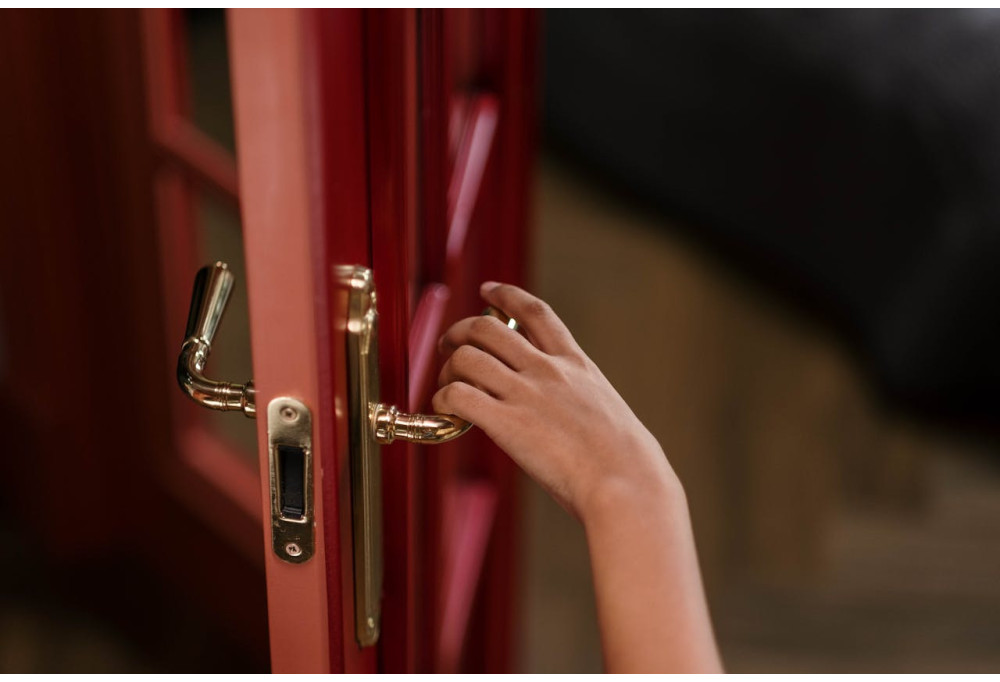
Are you planning to install or replace a door handle and finding yourself faced with incomprehensible jargon for an accessory that seems so simple? Rest assured: the specialists at milla handles are here to help you decode every component of your door handle.
We review the different categories of handles and their mechanisms, illustrating our explanations to make them easier to understand. After this, all those terms that seemed complex will appear clearer and more comprehensible.
The common elements of a door handle
Whatever the model, certain parts are common to all door handles. Understanding these elements will help you make the right choice when purchasing or installing.

Lever
The door lever is the part you grip to operate the door. It consists of two elements:
- Bar: Horizontal part that you grip.
- Neck: Zone connecting the bar to the plate or to the rose. The neck can be raised to accommodate doors with mouldings. Conversely, it can be lowered to allow, for example, the passage of a roller shutter. Handle sets fitted with a lowered neck are commonly referred to as "reduced projection sets".

Some models are fitted with a return spring, allowing the handle to return automatically to its initial position after use. On certain references, this spring also allows a lever lift of 45°, compatible with specific locks.
Square

The door spindle is a square-section metal rod that passes through the door and connects the two levers. It allows the lock mechanism to be operated. Standard dimensions vary: 7 mm in France, 8 mm according to the European standard, and 6 mm for certain renovations.
Plate or Rose

These two elements serve as a support for the lever and protect the door against fingermarks and dirt. To tell them apart, you need to know that:
- The plate is a rectangular or oval support on which the lever is fixed.
- The rose is a circular or square support, more discreet, often used in contemporary designs.
The different types of door handles
Door handles are not all alike: they come in a variety of configurations, meeting specific uses, styles, and technical constraints. Two main families stand out: plate-mounted handles and rose-mounted handles. Each has its own characteristics in terms of fixing, drilling, and adaptation to locks.
Plate-mounted door handles

This is the most common type of handle in homes in France. Its simple appearance nonetheless conceals a great diversity of models, particularly in terms of shapes, finishes, and fixing systems.
What is a plate?
The plate refers to the metal support on which the handle rests. It can be rectangular, rounded, or adopt specific decorative shapes such as wrought iron. This piece ensures the connection between the elements of the handle on the same side of the door, and may feature an opening (drilling) for a lock or a cylinder.
Some models incorporate a sub-plate in plastic (ABS, polyamide) or metal, sometimes fitted with a sealing gasket. This additional piece reinforces stability and improves the airtightness of the door, particularly in well-insulated buildings.
Drilled plate-mounted handles

In this configuration, both plates are drilled to allow connecting screws to pass through. These screws pass through the door and connect the two plates together, ensuring stable fixing. The screw heads remain visible on both sides of the door. This system is particularly suited to interior doors.
Plate-mounted handles with pillars

In this case, only one of the two plates is drilled. The other features tapped pillars (two or sometimes three) that receive the screws from the first plate. This method allows the screws to be concealed on the exterior side, which enhances security. This is why it is often used for entrance doors or doors facing the outside.
Rose-mounted handles

Unlike plate-mounted models, the rose-mounted handle consists of two circular elements: one for the handle, the other for the lock or cylinder. This minimalist design visually separates the opening and locking functions.
This format allows greater flexibility of adaptation, particularly on doors drilled to non-standard centres. It thus avoids the need to modify the door to install the handle. However, fitting may require a little more precision, depending on the model.
Beware of confusion: handle, lock, and cylinder

It is common to confuse the handle with the lock or the cylinder. However, these elements are distinct and sold separately. The handle provides the grip, the lock provides the mechanical locking, and the cylinder allows the use of a key. It is therefore essential to choose a handle that is compatible with the type of lock installed.
Types of drillings for plates and roses
Depending on the door's locking system, the plate or rose of the handle must be adapted with a specific drilling. Here are the main variants:
- Door handles with plates for latch lock: No key drilling. Intended for doors with a simple half-turn bolt (bathroom doors, cupboards…).

- Door handles with plates for L key: Drilling intended for classic key or lever tumbler locks.

- Door handles with plates for I key: Designed to accommodate a European cylinder.

Note: there are also door handles with plates for I key and cylinder reinforcement. These models incorporate a specific opening allowing the passage of a cylinder reinforcement, used in particular on multipoint locks to strengthen security against cylinder pulling or drilling.

- Door handles with privacy/emergency plates: One plate features an interior locking button, the other an emergency release hole accessible from the outside of the room.

- Door handles with plates featuring a locking indicator: Same configuration as above, with a two-colour indicator (red/green) showing whether the door is locked or not.

- Landing plates with fin: One plate has a standard handle, the other a fixed handle (fin), allowing opening only by key from the outside.

Comments
No comments yet!
Leave your comment