


.jpg)
.jpg)

DOOR LOCK AXIS - DEFINITION AND EXPLANATION
Lock axis: everything you need to know before choosing a suitable handle
Lock axis: everything you need to know before choosing a suitable handle
Let's talk about locks and door handles! If you think that choosing a handle for your front door or French windows is simply a matter of aesthetics, think again. A crucial element that is often overlooked must be taken into account: the lock axis. This technical aspect, although it may seem minimal, plays a fundamental role in the efficiency and aesthetics of your door. So how do you define this axis that allows you to operate a door's locking mechanism? We will show you why and how this small measurement can have a big impact on your daily life.
1. What is a door lock axis?
Before delving into the numbers and measurements, understand the difference between the various locks available through the following video.
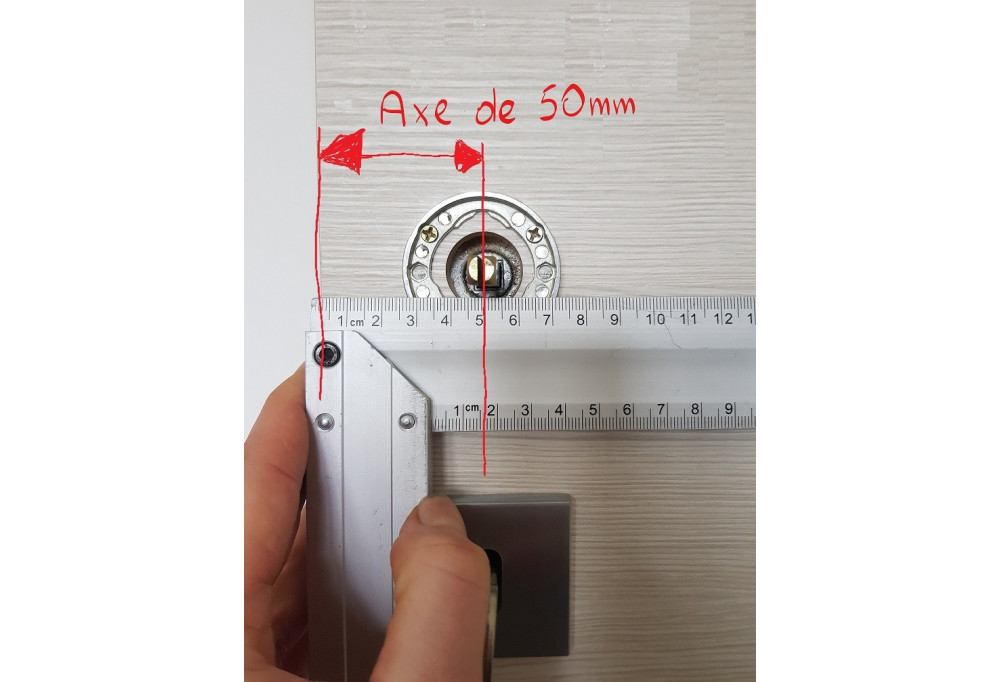
Next, the door lock is a technical term, but understanding it is crucial for the right choice of your door handles. By definition, it is the distance between the faceplate of the door lock (the part fixed to the door frame where the latch locks) and the central axis of the handle. This distance, measured in millimetres, is the axis around which the body of the handle rotates, thus allowing the rotation necessary to open or close the door. This measurement typically varies between 25 mm and 60 mm. In the case of single-point locks, commonly used on hinged doors, this axis determines not only the position of the handle but also that of the deadbolt, which locks to secure the door. The presence of a precisely dimensioned small axis ensures optimal operation of the handle, while a defined space between the axis of rotation and the axis of symmetry guarantees smooth opening of the door. The lock configuration may also include a sort of small ring, added to reinforce security and ensure effective locking.
Take a look at the image below and you will know how to measure a door lock axis.

In Europe, wooden doors frequently use 50 or 55 mm locks, particularly in Italy and Belgium. In France, the common standard is 40 mm. For aluminium or PVC doors, shallower locks of 30 or 35 mm, are preferred.

2. Why should you check the lock axis before buying a door handle?
Why is it so crucial to choose the right size for your handle and check the axis of your locking system? The lock axis is essential to build functional symmetry between the handle and the lock. Let's imagine for a moment: you have purchased a superb door handle, but once installed, it hits against the door frame. Frustrating, isn't it? To avoid this inconvenience, make sure that the axis of the locking system corresponds to that required by the handle. This consideration is all the more important for multi-point locks, often used for enhanced security. A poorly adapted axis can lead to alignment problems, which affect not only the aesthetics of the door but also its functionality. When you operate the handle, the entire body rotates to activate the mechanism, which ensures the security of your door.
Another example, a door handle on a concealed plate designed for a 5 cm axis will not be suitable for a 4 cm lock.

Let's take a typical Italian door with a 5 cm axis. Looking at the photo below, note that the proximity of the knob to the frame is notable. This configuration would not be possible with a lock axis of 40 mm, as the knob simply could not be installed correctly.

3. Backset and fixing
After checking the axis, it is equally important to measure the backset and fixing backset. The backset must correspond to the lock specifications to ensure a harmonious installation. This measurement is particularly important for doors with mortice locks, where the precision of orientation and origin is vital for the proper functioning of the door.

The lock axis, although often overlooked, plays a fundamental role in choosing handles and locks suitable for your doors and windows. It is a key element that ensures not only functionality but also the aesthetics of your doors. If you have any doubts or questions, please do not hesitate to contact us. At Millapoignées, we are here to guide you through these technical and aesthetic choices for your interior.
Comments
No comments yet!
Leave your comment