


.jpg)
.jpg)
How to choose the right interior door lock?
Interior door lock: magnetic or mechanical?
Interior door lock: magnetic or mechanical?
The interior door lock is used to secure a specific space. It comes in different types of models that can be used depending on the construction, the locking system, or the type of installation required according to the expected level of security. Follow the guide to find the model that suits you.
What is a lock and what is it used for?
A true security device, the interior door lock serves to lock an access point or a door. It works with mechanisms such as cards, codes, or keys that allow only authorised persons to access a protected space.
Interior door locks are used everywhere, whether at home, in the office, or in other publicly frequented places. They ensure the security of property and people, prevent access to an unauthorised location, and preserve privacy.
The different types of locks according to their construction
When buying doors, you should take the time to carefully choose your interior door locks to ensure the security of your home. Based on your preferences and needs, choose the appropriate models taking into account the type of construction offered.
For interior doors, there are four types of locks when taking into account the construction and the specific features of the lock mechanism:

- The keyless lock is one of the most common types of locks for interior doors. Instead of being fitted with bolts that engage with a key, it has only a small latch (half-turn) that keeps the door closed in the frame. To open and close the door, you do not need a key. You simply need to use a handle or a rotating knob that makes the task easier.
- The key lock "L" also known as "bedroom key" features both a bolt and a handle. Thanks to these different elements, you can lock the door by inserting a key directly into the lock through a plate. There are also versions without a separate bolt, where the locking latch plays the role of the bolt. When you turn the key, the cam is locked in the frame and you can only open the door by pushing down on the handle. In this case, only the key is able to unlock it.
- The cylinder lock (also called cylindrical lock, insertion lock, cylinder, Yale, "i" key): with its mechanism featuring a slot for a cylinder, to be purchased separately, this model is a more advanced option than the standard key lock. Even if this element represents an additional expense, it allows you to choose a cylinder suited to your needs. For example, its quality can be guaranteed through an appropriate certificate.
- The privacy lock is primarily dedicated to bathroom door handles and toilet doors. This mortise lock has a particular mechanism, with a "butterfly" turn on the interior side that allows the door to be locked from inside. From the outside, the lock can also be unlocked using a flat object, such as a cutlery item or even a coin. This solution can be used in an emergency, particularly when someone faints inside the room in question.

Locks according to their locking system
Beyond their construction method, interior door locks also differ in their locking system. Among the many models available on the market, mechanical and magnetic locks stand out not only in terms of the mechanism used but also in their functional and aesthetic aspects.
The mechanical lock: how it works
Its strengths
Having been on the market for years, the mechanical lock operates in a simple way and is suited to low-traffic areas. It is fitted with a latch that is easy to see when the door is open. When you close the door, this piece retracts into the lock after striking part of the strike plate. Once the door leaf is in the frame, the latch enters the locking pocket to close the door. To open it, simply press down on the handle.
Mechanical locks are part of the mortise locks category. They have the advantage of being sturdy and resistant to incorrect use, such as excessive force or when children pull on the door handle. However, they do have a few drawbacks.
Its weaknesses
When the door closes, the latch striking the strike plate produces a metallic noise, especially if the door is closed abruptly. Moreover, from an aesthetic point of view, the strike plate covers part of the rebate edge, so that the latch touches the plate rather than the frame when closing. Note that the mechanical lock is the only solution available for rebated doors.

The magnetic lock: how it works
Its strengths
Unlike the mechanical lock, the magnetic lock is used exclusively on adjacent doors. Well known in Italy and popular in France for a few years, this interior door lock appeals to lovers of aesthetic décor. Compared to a mechanical lock, it is flat and more discreet, as the strike plate is concealed in the rebate, which improves its visual appearance. The locking cam also remains hidden when the door is open.

The magnetic lock works thanks to a magnet. It engages when the door leaf touches the door seal and the cam does not strike the metal plate, which prevents the door-slamming effect. This model is therefore quieter and makes a noticeable difference compared to classic locks.
Its weaknesses
The main drawback of this magnetic lock lies in its sensitivity to incorrect handling. Although it should not be treated with excessive care, it is preferable to avoid slamming the door or applying excessive force when closing. Care should also be taken to prevent children from pulling on the handle, as this could place undue pressure on the structure. These magnetic locks are available in a variety of colours, offering the possibility of aesthetically matching their shade with that of the handles.
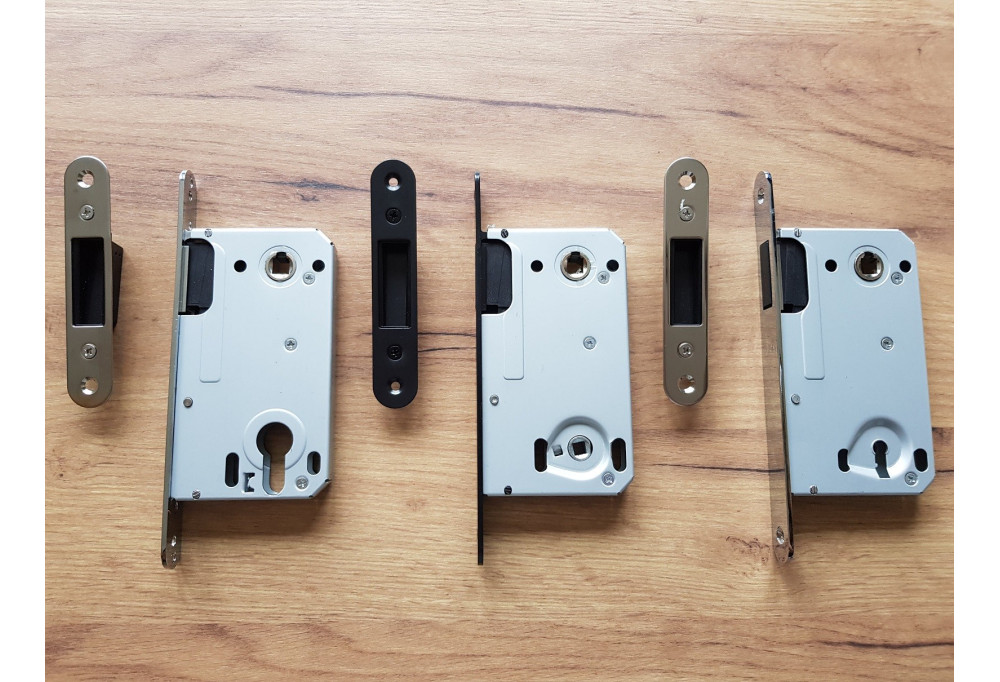
Through the image below, discover our range of colours of magnetic locks available on Millapoignees. You can easily match their appearance with that of your door handles.

All the advantages at a glance:
- no lubrication or maintenance required;
- flush latch that gives an attractive appearance;
- Presence of a modern neodymium magnet that automatically activates the latch for a smooth closure;
- reduced installation costs;
- the faceplate and the body of the lock are made of stainless steel;
- the locking elements are concealed and do not touch the frame, providing silent operation.
Dimensions compliant with standards
The lock backset, which measures 70 mm, complies with the French standard, and the 72 mm one follows the European standard. As for the lock faceplate, if it is 23 cm in length in the French standard, it is 20 cm for Italian locks. For the French market, we recommend the magnetic lock design Bonaiti B-France. In the illustration below, you will find all the finishes available for this quality Italian lock:

On Millapoignees, we offer a full range of mechanical and magnetic locks in Italian style. This concept aims to use a single locking latch and to reduce the visible part of the lock in the door leaf and the frame.
To reduce the noise when closing the door, the latches of our models are made of ABS polymer. Our designer locks are compatible with all handle models available to you.

Summary - Is it worth it?
With current technological advances, the magnetic lock offers an almost silent closure, avoiding the typical "click" of mechanical locks even when used more forcefully.
Magnetic locks offer 5 key advantages, with particular emphasis on:
- Discreet closure: Thanks to their flat design, magnetic locks eliminate the risk of damaging clothes and ensure a closure without the metallic noise associated with mechanical locks.
- Effortless closure: The attraction of the magnets allows for a smoother closure without needing to press down on the handle. How does it work? Pull or push the door gently and it will close.
- Exceptional durability: With a lifespan of nearly 400,000 cycles, magnetic locks outperform mechanical locks, with reliable long-term use.
- Aesthetically cohesive: The aesthetic design of magnetic locks integrates them perfectly with all interior doors, thus eliminating visual incompatibility issues.
- Environmentally responsible: Made with safe materials and complying with strict ecological standards, magnetic locks offer a modern solution while contributing to the preservation of the environment.
If you are looking for solutions that are both modern, elegant, and durable, magnetic locks for interior doors stand out as an exceptional choice. And for those who care about preserving our environment, here is excellent news: these locks are made from safe materials, with a production process strictly governed by rigorous ecological standards.
Comments
No comments yet!
Leave your comment